


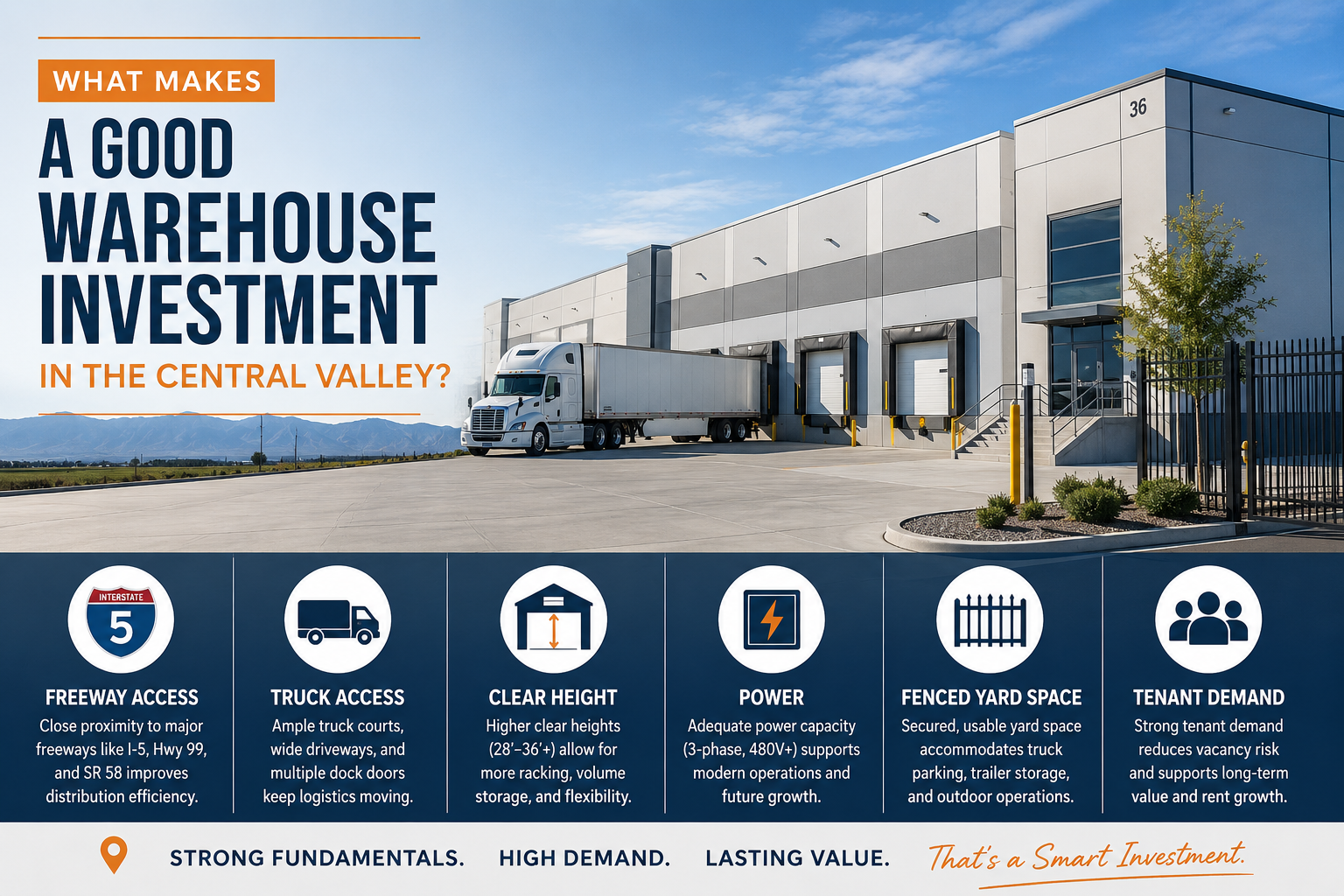
What Makes a Good Warehouse Investment in the Central Valley?
The Central Valley of California is rapidly becoming a key logistics hub, offering a strategic alternative to the increasingly congested and expensive coastal markets. For commercial property owners and industrial real estate investors, finding the right property means focusing on a specific set of critical physical and logistical features that directly impact tenant demand and long-term asset value. Whether you are expanding your portfolio or evaluating a potential acquisition, here is a detailed breakdown of the structural and market factors that make a warehouse investment “good” in this vital region.
1. Strategic Freeway Access and Connectivity
The backbone of Central Valley logistics is its primary transportation corridors. A premier warehouse property must feature excellent proximity to major north-south arteries, specifically Interstate 5 (I-5), Highway 99, and SR 58. This geographic advantage delivers two critical benefits to industrial operators:
- Regional Connectivity: The Central Valley serves as the connecting tissue between the major population centers of Northern and Southern California. Seamless highway proximity minimizes “last-mile” travel times to reach both the San Francisco Bay Area and the Greater Los Angeles region.
- Reduced Transit Times: For logistics and distribution tenants, time is money. A facility located adjacent to a key highway interchange significantly reduces transit times, lowering transportation costs and increasing overall supply chain efficiency.
2. Designed for Efficient Truck Access
It is not enough for an industrial asset to be near a freeway; the property footprint itself must be optimized for heavy truck traffic. Poor site design leads to logistical bottlenecks that frustrate tenants and increase vacancy risks. High-performing warehouse investments display superior site functionality, including:
- Ample Truck Courts and Turn Radii: The site should feature wide turning radii at entrances and exits to accommodate 53-foot tractor-trailers, paired with generous truck courts that allow trucks to navigate efficiently between the street and the loading docks.
- Multiple Dock Doors and Staging: Having an adequate number of dock-high and grade-level doors keeps logistics moving. Furthermore, dedicated staging areas allow incoming or outgoing trucks to wait safely before moving to a dock door, preventing backups on public streets.
3. Meeting Modern Standards for Clear Height
Clear height—the usable height inside the warehouse from the floor to the lowest hanging ceiling obstruction (such as sprinklers, trusses, or lighting)—is a major driver of rental premiums. In modern logistics, storage capacity is calculated by cubic volume, not just square footage.
Higher clear heights (typically 28′–36′+) allow tenants to stack pallets higher, install modern racking systems, and maximize volume storage and flexibility.
While a 28-foot clear height was once acceptable, premier modern facilities are increasingly targeting 36 feet or higher. Investing in properties with maximum cubic volume “future-proofs” your industrial asset, keeping it highly competitive for high-volume e-commerce and third-party logistics (3PL) tenants who utilize automated storage and retrieval systems (AS/RS).
4. Robust Power Capacity and Infrastructure
The electrical needs of modern warehouse operations are expanding exponentially, far exceeding basic lighting and office requirements. Investors must audit a property’s utility capacity to ensure it supports modern operations and future growth:
- Automation and Sorting Systems: High-volume e-commerce fulfillment centers require heavy power loads to run high-speed sorting systems, conveyors, and complex robotic automation.
- Three-Phase Power: High-value properties offer heavy, reliable 3-phase, 4000V+ power capacity directly to the facility, or possess immediate utility infrastructure nearby to upgrade capacity as electrical fleet charging and automation needs skyrocket.
5. Essential Fenced Yard Space
Often overlooked by novice investors, the external yard space is just as vital as the internal square footage for industrial operations. Secured, usable yard space provides major competitive advantages in the Central Valley market:
- Trailer Storage and Parking: Many operators require dedicated, secure yard space to accommodate fleet vehicle parking, container stacking, and empty trailer storage.
- Outdoor Operations: A fully fenced, secure perimeter allows for safe outdoor operations and storage of bulk materials that do not require indoor climate control, reducing liability risks for the asset.
6. Driven by Sustained Tenant Demand
Ultimately, the physical attributes of a warehouse only matter if there is a strong, sustained tenant demand to fill the vacancy. Strong tenant demand reduces vacancy risk, stabilizes cash flow, and supports long-term value and rent growth. The Central Valley market is uniquely positioned due to macro-economic drivers:
- E-Commerce Growth: The ongoing expansion of online retail relies on the Central Valley as a vital regional fulfillment hub capable of reaching nearly the entire California population within a single day’s drive.
- Affordability and Availability: Land prices and labor costs in the Central Valley remain significantly lower than in land-constrained coastal markets. Combined with a robust, available workforce, this affordability makes the region an ideal location for large-scale distribution and manufacturing operations.
Conclusion: Investing on Strong Fundamentals
A successful warehouse investment in California’s Central Valley is driven by structural utility and operational efficiency. By prioritizing properties that deliver strong fundamentals, high demand, and lasting value—specifically through superior freeway access, optimized truck courts, high clear heights, robust power infrastructure, and secured yard space—commercial real estate investors can secure resilient, high-performing industrial assets built for the future.
Frequently Asked Questions
What is considered a good clear height for a warehouse investment today?
While a clear height of 28 feet was historically standard, modern logistics operators look for 32 to 36 feet or more. Higher clear heights allow tenants to maximize their cubic storage volume, accommodate advanced racking systems, and future-proof the building against changing e-commerce requirements.
Why is fenced yard space important for Central Valley industrial properties?
Secured, fenced yard space allows logistics tenants to safely store empty trailers, manage fleet parking, and conduct outdoor operations. Properties that feature a secure perimeter and ample yard space command a premium because they prevent on-site congestion and minimize cargo theft risks.
Which freeways are most critical for warehouse distribution in the Central Valley?
The primary transportation corridors driving logistics efficiency in the region are Interstate 5 (I-5) and Highway 99, along with key connecting routes like State Route 58 (SR 58). Proximity to these major arteries ensures fast regional connectivity to both Northern and Southern California population centers.