


NNN Lease vs. Gross Lease: What Every Commercial Property Owner and Investor Must Know
In commercial real estate, choosing the right lease structure is one of the most critical decisions impacting your long-term profitability and asset valuation. Before a lease agreement is signed, understanding what is included in the base rent—and what is passed along to the tenant—can mean a difference of thousands of dollars a month in cash flow. For commercial property owners, apartment building investors, and business tenants alike, the choice between a Triple Net (NNN) lease and a Gross lease fundamentally shapes the distribution of operational risk and financial predictability.
The two lease types you will encounter most frequently in commercial markets are the Triple Net (NNN) lease and the Gross lease. They are structured in completely opposite ways. Selecting or offering the wrong framework can quietly drain operating budgets or leave landlords exposed to volatile market expenses. Here is an authoritative, plain-English analysis of both frameworks—detailing the exact cost structures, risk allocations, and strategic advantages of each.
The Core Difference: Expense Allocation
The fundamental distinction between these two lease types lies in who absorbs the day-to-day operating expenses of the property:
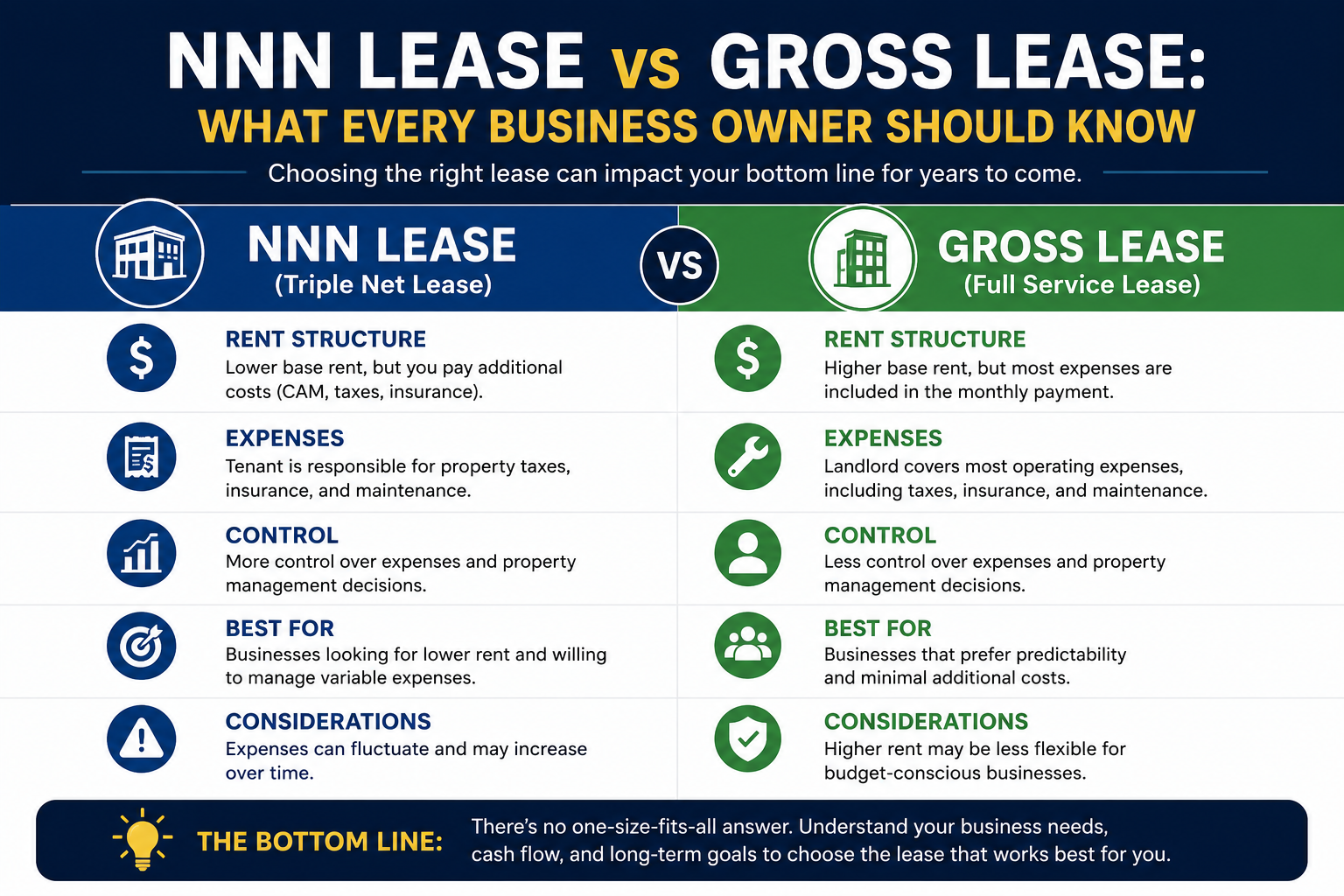
- NNN Lease (Triple Net Lease): Features a lower base rent, but the tenant is responsible for additional variable costs, passing property taxes, insurance, and maintenance directly through to the occupant.
- Gross Lease (Full Service Lease): Features a higher base rent, but most operating expenses are completely bundled into one predictable, flat monthly payment covered by the landlord.
Visual Breakthrough: Financial Risk & Expense Split
Triple Net (NNN) Lease
*Risk Profile: High variability for tenant as expenses fluctuate.
Gross (Full-Service) Lease
*Risk Profile: Maximum predictability for tenant; landlord manages overhead.
Breaking Down the NNN (Triple Net) Lease
Under a NNN lease structure, the landlord passes the majority of ongoing operational costs directly to the tenant on top of the established base rent. The “triple” specifically refers to three operational net expenses:
| The “Three Nets” | What It Covers | Who Holds Operational Control |
|---|---|---|
| Property Taxes | The tenant’s proportionate share of annual real estate taxes assessed on the property. | Landlord manages tax obligations; tenant reimburses their share. |
| Building Insurance | Property insurance covering hazards, casualty losses, and liability related to the building structure. | Landlord maintains the insurance policy; tenant pays their allocated portion. |
| CAM Charges (Common Area Maintenance) | Costs associated with maintaining shared areas, including landscaping, parking lot repairs, lighting, security, and roof maintenance. | Landlord oversees maintenance and vendor management; tenant pays their share of expenses. |
In multi-tenant commercial buildings or retail centers, these costs are typically allocated pro-rata based on square footage. For instance, if a business occupies 10% of the building’s total square footage, they are billed for 10% of the property’s aggregate taxes, insurance, and CAM charges. Because these operational numbers fluctuate year over year, a severe property tax reassessment or unexpected structural maintenance can cause the tenant’s monthly occupancy costs to jump significantly.
Investor Insight: Commercial property owners must remain highly transparent. Sophisticated tenants will always request a comprehensive CAM reconciliation from prior operating years before signing an NNN lease to verify historical actuals against marketing projections.
Breaking Down the Gross Lease
A Gross lease simplifies commercial tenant billing significantly. The tenant agrees to a fixed monthly amount, and that single payment covers the vast majority of occupancy costs. In a true full-service gross lease, even building utilities and janitorial services are absorbed by the landlord.
However, “gross lease” is a broad umbrella term. In many commercial and office markets, you will frequently encounter Modified Gross Leases. This hybrid structure allows for negotiation: the landlord might absorb property taxes and building insurance, while the tenant pays directly for their own utilities and interior janitorial services.
| Expense Line Item | Full-Service Gross Lease | Modified Gross Lease |
|---|---|---|
| Property Taxes | Covered by Landlord | Covered by Landlord |
| Building Insurance | Covered by Landlord | Covered by Landlord |
| CAM / Maintenance | Covered by Landlord | Negotiable / Split |
| Utilities | Covered by Landlord | Paid by Tenant |
| Janitorial Services | Covered by Landlord | Paid by Tenant |
Cost, Risk, and Predictability: The Three Core Metrics
When analyzing or executing these lease structures, three primary financial factors must drive your portfolio strategy:
1. Total Occupancy Cost vs. Base Rent
NNN leases typically present a significantly lower headline base rent, which can look highly attractive on marketing flyers. However, once pro-rata property taxes, insurance, and CAM charges are factored in, the true all-in occupancy cost often equals or exceeds a comparable gross lease rate. Smart investors and tenants always evaluate the all-in numbers rather than the face value base rent.
2. Risk Exposure and Reassessment
Under an NNN lease, the tenant completely absorbs the financial risk of rising operational costs. If county property taxes jump or insurance premiums skyrocket, the tenant’s monthly overhead increases automatically—regardless of personal business performance. Under a gross lease, that operational risk sits entirely with the landlord. While a landlord can adjust rates upward during lease renewal periods, their cash flow is exposed to expense spikes during the active lease term.
3. Financial Predictability
Gross leases offer unmatched budgetary predictability. For businesses operating with tight margins or medical/professional practices requiring highly consistent overhead forecasting, gross structures are ideal. NNN leases introduce variability, and unexpected spikes in business overhead can significantly disrupt operating capital.
Real-World Financial Example: Consider a commercial space listed with an NNN lease at $1.80/SF. Once you add $0.45/SF for property taxes, $0.20/SF for building insurance, and $0.35/SF for CAM charges, the real all-in cost scales to $2.80/SF. A comparable gross lease down the street offered at a flat $2.65/SF would actually deliver a more cost-effective bottom line. The headline number was misleading.
Strategic Fit: Which Lease Aligns with Your Goals?
There is no universally superior lease structure; instead, choose the framework that aligns with the asset class, cash flow requirements, and long-term risk tolerance of both parties.
An NNN Lease is best suited for:
- Freestanding retail buildings, single-tenant properties, and high-volume industrial warehouses.
- Well-capitalized corporate tenants capable of managing variable operational expenses.
- Landlords seeking passive income with minimal property management responsibilities.
A Gross Lease (or Modified Gross) is best suited for:
- Multi-tenant office buildings, executive suites, and medical office properties.
- Startups, professional service firms, and businesses that require locked-in, predictable monthly overhead.
- Landlords who prefer to maintain tight operational control over asset maintenance and build expense premiums directly into the rent.
Crucial Clauses to Negotiate Before Signing
Everything in commercial real estate is negotiable. Whether you are structuring an NNN or a Gross lease agreement, safeguard your cash flow by addressing these four critical protections:
- CAM Caps: In an NNN lease, always negotiate an annual cumulative cap on CAM increases (typically 3% to 5% per year). This prevents extreme expense spikes if major maintenance issues arise.
- Audit Rights: Ensure the lease text grants the tenant the right to formally audit the landlord’s operating expense and CAM books annually to verify billing accuracy. Overbilling in CAM reconciliations is more common than most tenants realize.
- Capital Expense Exclusions: Explicitly exclude foundation repairs, structural roof replacements, and major capital improvements from CAM charges. These are asset-appreciating expenses that should remain the sole responsibility of the property owner.
- Base Year / Expense Stops: When executing gross leases, carefully analyze “base year” clauses. These provisions can shift operating cost increases over a specific baseline back to the tenant after the first year, blurring the line between a gross and NNN structure.
Frequently Asked Questions
What is the main difference between a NNN lease and a Gross lease?
The primary difference is how property operating expenses are handled. In a NNN (Triple Net) lease, the tenant pays a lower base rent plus their pro-rata share of property taxes, insurance, and common area maintenance (CAM). In a Gross lease, the tenant pays a single, higher flat monthly fee, and the landlord covers all property taxes, insurance, and maintenance costs.
Why do landlords prefer NNN leases?
Landlords prefer NNN leases because they shift the risk of rising operational costs (such as increasing property taxes or insurance premiums) entirely to the tenant. This creates a highly predictable, passive income stream for the property owner, insulating their investment yields from inflationary pressures.
Can a Gross lease contain hidden fees or expense increases?
Yes. Many gross leases include “Base Year” or “Expense Stop” clauses. These clauses state that the landlord will cover operating expenses up to the amount incurred during the first year of the lease. If property expenses increase in subsequent years, the tenant is billed for the difference, making it behave similarly to a net lease structure.