


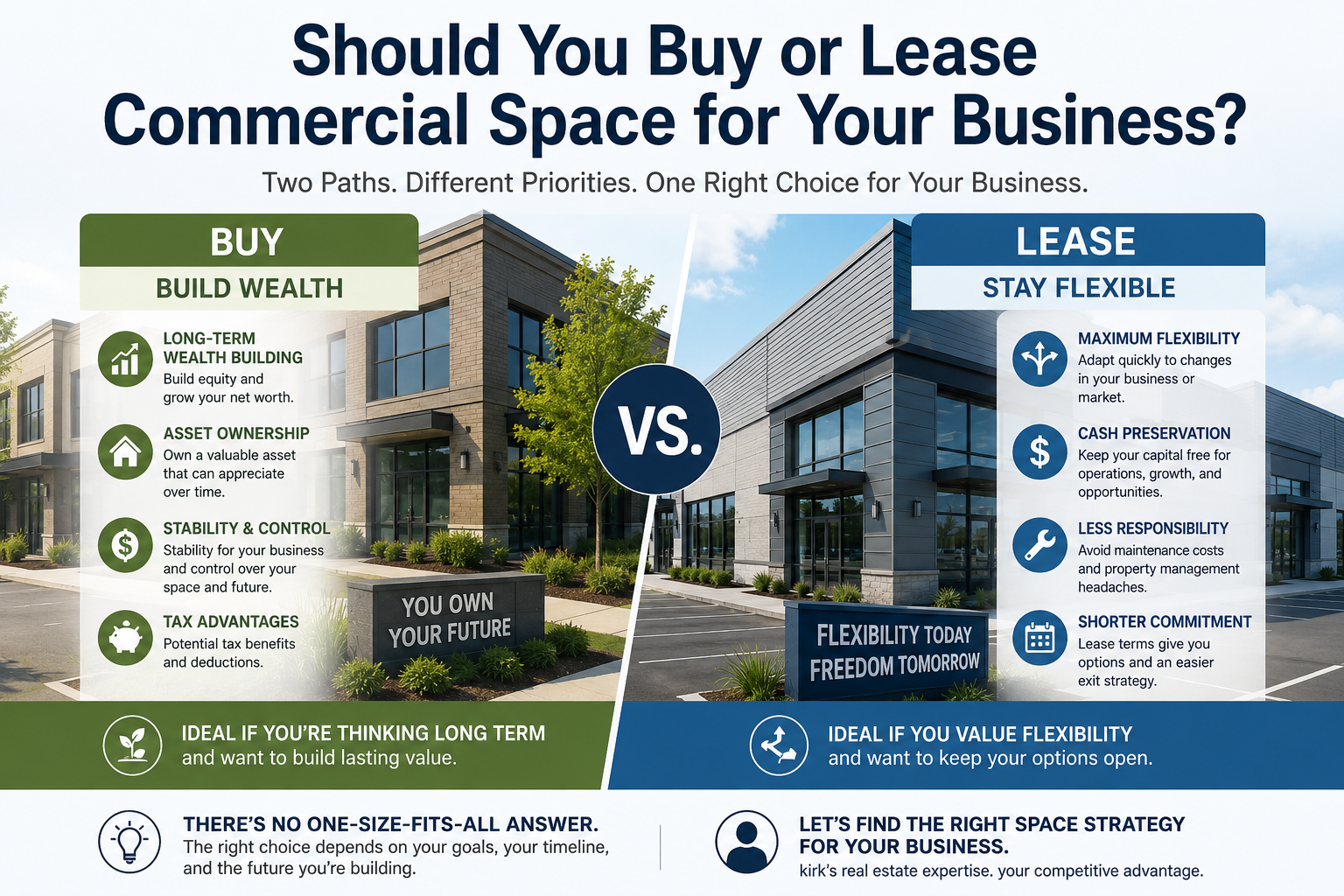
Should You Buy or Lease Commercial Space for Your Business?
One of the most defining crossroads for any growing business or commercial real estate investor is deciding whether to buy or lease commercial space. It is a decision that shapes your financial trajectory, operational agility, and long-term net worth. There is no one-size-fits-all answer; the right choice depends entirely on your specific business goals, operational timeline, and the financial future you are actively building.
To help you navigate this pivotal milestone, let’s analyze the two paths, examine their distinct priorities, and determine which strategy aligns with your corporate vision.
The Buy Path: Building Long-Term Wealth and Control
Choosing to buy commercial property is fundamentally an investment in wealth building. For well-capitalized, established business owners, ownership transitions real estate from an ongoing operational expense into a powerful, wealth-generating corporate asset.
1. Long-Term Wealth Building & Equity
When you pay a commercial mortgage, you aren’t simply paying for space—you are building equity. Over time, principal paydown combined with historical property appreciation systematically grows your business’s net worth, creating a tangible corporate reserve.
2. Valuable Asset Ownership
Ownership places a high-value, stabilizing asset directly onto your balance sheet. Commercial real estate historically serves as an excellent hedge against inflation, allowing you to control a scarce resource that can appreciate significantly over a long-term horizon.
3. Absolute Stability & Operational Control
Lease expirations inherently bring risk: rent hikes, landlord disputes, or forced relocations. Purchasing your facility guarantees complete operational stability. You have absolute control over your physical space, customized build-outs, and future expansion options without needing third-party approval.
4. Substantial Tax Advantages
Owning commercial property unlocks sophisticated tax benefits. Owners can often deduct annual mortgage interest, property taxes, and operational expenses. Furthermore, non-cash depreciation deductions can heavily offset your business’s taxable operating income.
Ideal for: Businesses looking long-term that possess the necessary capital to anchor themselves, build lasting equity, and fully capture the financial upside of property appreciation.
The Lease Path: Prioritizing Flexibility and Cash Preservation
Conversely, choosing to lease commercial property is a strategic decision centered around staying flexible. It allows businesses to remain highly agile, lean, and unencumbered by the capital restrictions of property management.
1. Maximum Market Flexibility
The modern business landscape moves incredibly fast. Leasing allows your enterprise to adapt quickly to changes in your specific industry or localized market. Scaling up to a larger footprint or downsizing to optimize overhead can be executed seamlessly at the end of your lease term.
2. Capital Preservation
Purchasing commercial real estate requires a massive upfront capital commitment, often a 20% to 35% down payment. Leasing keeps your valuable liquidity completely free. This preserved capital can be deployed directly into higher-ROI operational expenses, such as inventory, talent acquisition, marketing, or immediate growth opportunities.
3. Reduced Maintenance Responsibility
Property management can easily become a major operational headache. In standard gross or modified lease structures, the landlord retains the core responsibility for structural maintenance, roof repairs, and general building upkeep, allowing you to focus 100% of your energy on core business operations.
4. Shorter Commitment & Easier Exit Strategies
A typical commercial purchase locks a business in for decades. Commercial lease terms give you defined timelines, predictable renewal options, and a much cleaner, low-risk exit strategy if your business pivots or chooses to relocate to a new market.
Ideal for: Startups, rapidly scaling companies, or businesses that value agility, preservation of liquid capital, and keeping their strategic options open.
Strategic Breakdown: Buy vs. Lease At a Glance
| Strategic Metric | Buying Commercial Space | Leasing Commercial Space |
|---|---|---|
| Primary Financial Focus | Wealth building, equity growth, and long-term appreciation. | Cash preservation, liquidity, and operational agility. |
| Upfront Capital Required | High (Down payment, closing costs, environmental reports). | Low (Security deposit and standard build-out costs). |
| Operational Control | Absolute. You control modifications, layout, and usage. | Restricted. Bound by lease terms and landlord approvals. |
| Tax Implications | Depreciation, mortgage interest deductions, and write-offs. | Lease payments are generally 100% deductible as operating expenses. |
| Maintenance & Risk | Full structural and operational responsibility. | Minimal responsibility; heavily managed by the landlord. |
Finding the Right Space Strategy for Your Business
Every business requires a distinct real estate strategy. Making the right choice demands an objective look at your historical cash flow, five-year growth projections, and localized market conditions. Aligning your property decision with your broader corporate objectives ensures your real estate acts as a catalyst for success rather than a financial anchor.
Partnering with a sophisticated commercial real estate expert helps you model out your true, long-term occupancy costs across both paths, ensuring your next move is your most profitable one.
Frequently Asked Questions
Is it financially better to buy or lease commercial space?
There is no universal answer. Buying is financially superior if you intend to stay in the space long-term, want to build equity, and have the capital to invest. Leasing is financially better if you need to preserve liquidity for business operations or require the flexibility to scale or relocate rapidly.
What are the main tax benefits of buying commercial property?
Commercial property owners can capitalize on significant tax deductions, including mortgage interest, property taxes, and actual property depreciation. Non-cash depreciation can significantly reduce your overall taxable business income, providing a major financial benefit over leasing.
How much down payment is required to buy a commercial building?
While residential loans often allow small down payments, commercial real estate purchases typically require a down payment ranging from 20% to 35% of the purchase price, depending on the loan type (such as conventional vs. SBA loans), the property type, and the borrower’s creditworthiness.